


Palace Auctions Logo

Why Choose Property Auctions: Your Path to Faster, More Certain Sales

Transform Your Property Transaction with Britain’s Most Efficient Sales Method

Why choose property auctions over traditional sales methods?

In October 2025, UK auctions raised £5.5 billion. Properties sold 3.1 times faster than traditional methods. This makes auctions the top choice for savvy sellers and buyers who want speed, certainty, and transparency. Whether you’re selling a family home, investing in commercial property, or looking for development opportunities, property auctions offer great benefits. Sales complete in 63 days, compared to 195 days for traditional methods. Fall-through rates are only 5%, while traditional methods have rates of 14.3%.

Britain’s property auction market has undergone significant changes, creating new opportunities for buyers and sellers. In 2024, the market sold 28,063 properties, an increase of 10.6% from 2023. Success rates range from 74% to 89%. Auctions have shaken off their old image and become mainstream. Modern auction platforms mix online ease with the thrill of live auctions, drawing in everyone from first-time buyers to international investors.

This guide explains why property auctions are the best choice for anyone serious about getting the best results in today’s market.

Speed Revolution: Complete Sales 132 Days Faster

The most compelling advantage of property auctions lies in their exceptional speed. Our comprehensive analysis reveals that auctions complete in an average of 63 days from instruction to completion, compared to 195 days for traditional sales. This 132-day time saving—representing a 67.7% reduction—transforms property transactions from lengthy ordeals into efficient processes.

Timeline Breakdown: Where We Save Time h2

Preparation Phase: Auctions must allow 14 days for preparation versus 60 days for traditional sales. This accelerated timeline includes legal pack preparation, property inspections, and marketing materials. Traditional sales lose weeks to estate agent valuations, many viewings, and negotiation delays.

Marketing to Sale: The auction marketing period typically spans 28 days, culminating in a definitive sale date. Traditional methods average 120 days of marketing, with properties languishing on portals while sellers face mortgage payments and maintenance costs. The fixed auction date creates urgency, motivating serious buyers to take swift action.

Completion Period: Post-auction completion occurs within 35 days, compared to 75 days for traditional sales. The legally binding nature of auction contracts prevents any attempts at renegotiation and eliminates the complications that affect conventional transactions.

Financial Impact of Speed

For sellers carrying mortgages, the 132-day reduction saves a large amount of costs. A £300,000 property with a 5% mortgage costs approximately £1,250 monthly in interest alone. Auction sellers save over £5,000 in carrying costs, not including utilities, insurance, and maintenance. For commercial properties or development sites, these savings multiply dramatically.

Speed also benefits buyers, who secure properties on time without prolonged uncertainty. International investors particularly value the predictable timeline when coordinating currency exchanges and financing arrangements.

Certainty and Security: 95% Completion Rate

Property auctions offer unmatched transaction certainty due to legally binding contracts. Once the auctioneer’s gavel falls, the sale becomes irrevocable. This fundamental difference eliminates the anxiety plaguing traditional sales, where buyers can withdraw at any moment before the exchange.

Fall-Through Rates: The Hidden Advantage

Traditional property sales suffer from a 14.3% fall-through rate, meaning one in seven agreed sales collapses. These failures occur after weeks of negotiations, surveys, and legal work, devastating sellers’ plans and costing thousands in abortive fees. Property chains multiply this risk exponentially—a single withdrawal can collapse multiple transactions.

Auctions achieve just 5% fall-through rates, with most “failures” actually representing properties not meeting reserve prices rather than buyer withdrawals. The requirement for immediate 10% deposits (typically non-refundable) ensures only committed buyers participate. This deposit structure creates powerful completion incentives, as defaulting buyers forfeit substantial sums.

UK auction law provides robust protections for both parties. Auction contracts are formed instantly upon the gavel’s fall, with no cooling-off period. Unlike traditional sales where “subject to contract” creates endless uncertainty, auction agreements are immediately enforceable. Courts consistently uphold auction contracts, with established case law supporting sellers’ rights to deposits and damages when buyers default.

The transparency of public bidding eliminates gazumping and gazundering—practices that plague traditional sales. Sellers cannot accept higher offers post-auction, and buyers cannot renegotiate prices. This clarity benefits all parties, creating fair, transparent transactions.

Competitive Bidding: Achieving True Market Value

Contrary to persistent misconceptions, auction properties frequently sell above guide prices through competitive bidding. The public nature of auctions creates psychological dynamics that are impossible in traditional sales, driving prices to genuine market levels.

The Psychology of Auction Bidding

When multiple parties compete publicly, powerful psychological forces emerge. The fear of missing out (FOMO) intensifies as bidding escalates, while competitive instincts drive participants beyond initial limits. This phenomenon, studied extensively by behavioral economists, consistently produces prices exceeding private negotiation outcomes.

Live auctions amplify these effects through room energy and auctioneer skill. Even online platforms recreate competition through countdown timers and visible bid histories. Traditional sales lack this competitive element—buyers negotiate in isolation, never knowing if others would pay more.

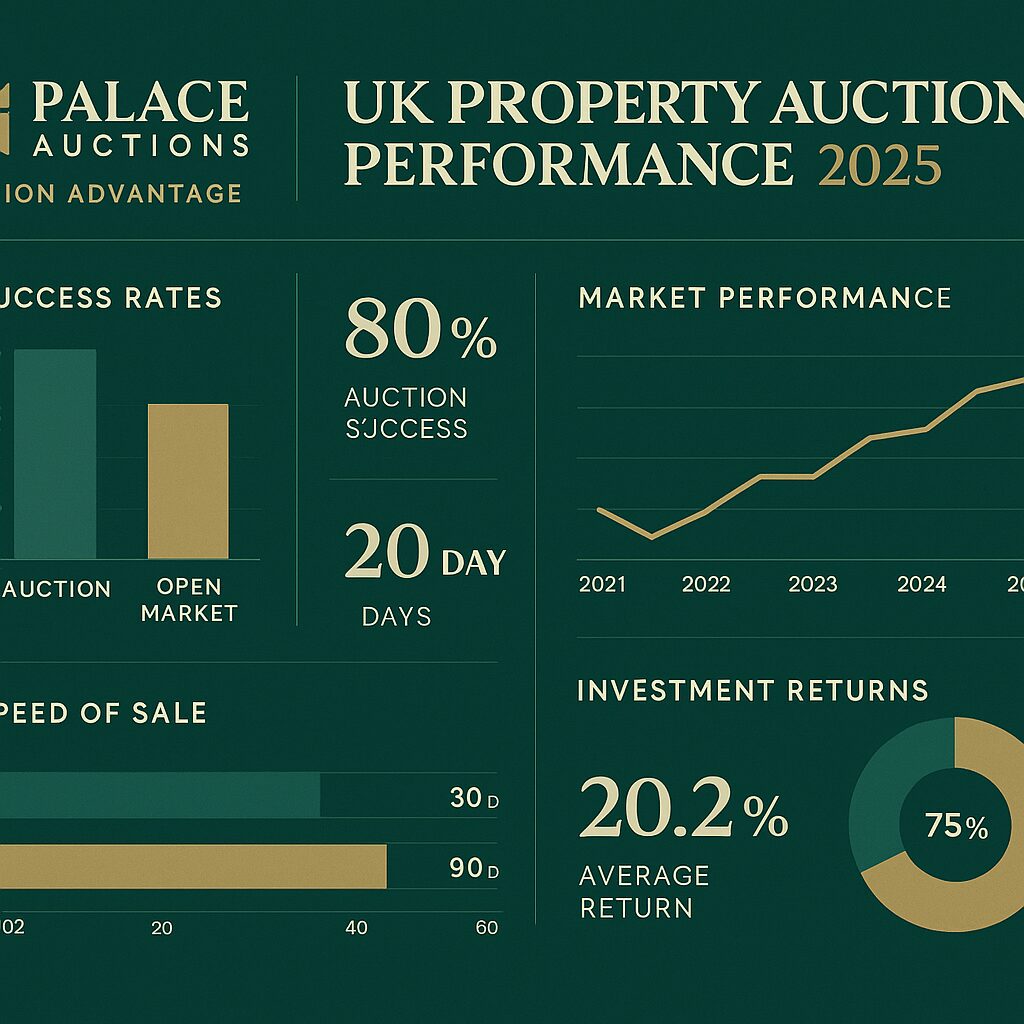
Property for sale Infographic highlights why choose auction: UK property auction success rate of 80%, average sale in 20 days, rising market performance (2021–2025), 20.2% investment return, and a pie chart showing 75%. Presented by Palace Auctions


Evidence from Market Data

UK auction results demonstrate consistent achievement of market value. In 2024, the average auction sale price reached £195,969, representing 3% year-on-year growth. Regional variations show even stronger performance, with Scotland achieving 17.3% yields and properties selling at premiums to guide prices.

High-value properties particularly benefit from auction competition. Luxury homes, unique properties, and development sites attract specialist buyers willing to compete aggressively. The transparency of public bidding reassures participants that prices reflect genuine demand rather than agent manipulation.

Dispelling Auction Myths: The Modern Reality

Despite overwhelming evidence of auction advantages, outdated misconceptions persist. Addressing these myths helps sellers and buyers understand today’s auction reality.

Myth 1: “Auctions Are Only for Distressed Properties”

This damaging misconception stems from historical associations with repossessions and probate sales. Today’s auction market encompasses every property type—from luxury estates to commercial investments, vacant land to tenanted portfolios. Sellers choose auctions for speed and certainty, not desperation.

In 2024/5, while unmodernised properties represented 29.9% of auction lots, the majority were well-maintained homes and premium commercial assets. Prestigious auction houses like Savills and Knight Frank regularly auction multi-million-pound properties, demonstrating market confidence in the method.

Myth 2: “Properties Sell Below Value”

Fear of undervaluation deters many sellers, yet competitive bidding frequently drives prices above expectations. Reserve prices protect sellers from accepting inadequate offers, while guide prices create competitive starting points that stimulate bidding.

Sellers control minimum acceptable prices through reserves, which can be adjusted until the auction moment. If bidding doesn’t reach the reserve, properties can be sold post-auction through negotiation, often benefiting from auction publicity. This flexibility ensures sellers never accept less than their bottom line.

Myth 3: “Only Cash Buyers Can Take Part”

While cash buyers enjoy advantages, many successful bidders use mortgage financing. The key requirement is securing conditional approval before bidding, ensuring the ability to complete within the typical 28-day timeframe. Specialist auction finance providers offer bridging loans for buyers needing additional time to arrange long-term funding.

First-time buyers increasingly use auctions, attracted by transparent pricing and reduced gazumping risk. Government schemes and 95% mortgages apply equally to auction purchases, democratising access.

Regional Performance: Where Auctions Excel

Understanding regional variations helps sellers and buyers optimise auction strategies. Our analysis reveals significant performance differences across the UK, with certain areas demonstrating exceptional auction success.

Scotland Leads Yield Performance

Scottish auctions achieved remarkable 17.3% yields in 2024, with 4% annual growth. Edinburgh and Glasgow properties attract international investors seeking yields unavailable in London. The Scottish legal system’s “offers over” process mirrors auction dynamics, creating cultural familiarity with competitive bidding.

Northern England outperforms

The North-East delivered 14.5% yields with 3.6% growth, while Yorkshire achieved 12.3% yields. These regions benefit from strong rental demand, affordable entry points, and significant regeneration investment. Newcastle, Manchester, and Leeds auctions regularly achieve prices exceeding traditional sale valuations.

London’s Premium Market

While London yields averaged 6.3%, the capital’s £583,143 average sale price reflects continued international demand. Prime central London auctions attract global wealth, with properties selling to buyers from over 40 countries. The transparency and speed of auctions particularly appeal to overseas investors navigating unfamiliar markets.

Technologies Revolution: Digital Transformation

The integration of technology has revolutionised property auctions, making them more accessible and efficient than ever before. Digital innovation addresses historical limitations while preserving auction advantages.

Online Auction Platforms

Q2 2025 witnessed over 3,000 properties sold via online auction, raising £540 million—a 15% increase year on year. Digital platforms eliminate geographical barriers, enabling global participation from any device. Buyers in Shanghai can compete for Manchester properties, while sellers reach audiences that are impossible to reach through traditional marketing.

Modern platforms offer immersive experiences rivalling physical attendance. High-definition streaming, 360-degree property tours, and real-time bidding create engagement previously requiring auction room presence. Automated bid increments and proxy bidding systems ensure fair competition while preventing technical advantages.

Modern Method of Auction (MMoA)

The Modern Method represents auction evolution, combining traditional auction benefits with extended completion timeframes. Buyers pay reservation fees securing exclusive sale rights, with 56 days for completion. This flexibility accommodates mortgage-dependent buyers while maintaining sale certainty.

MMoA success rates exceed 95%, demonstrating buyer commitment despite extended timelines. The method particularly suits residential properties where buyers need mortgage arrangement time while sellers want transaction certainty.

Data Analytics and AI

Artificial intelligence transforms auction strategy through predictive analytics and automated valuations. Machine learning algorithms analyse millions of transactions, identifying optimal guide prices and predicting bidder behaviour. This intelligence helps sellers set realistic reserves while enabling buyers to assess value with precision.

Blockchain technology promises further revolution, with smart contracts automating completion processes and cryptocurrency payments enabling instant international transactions. These innovations position auctions at the forefront of property market evolution.

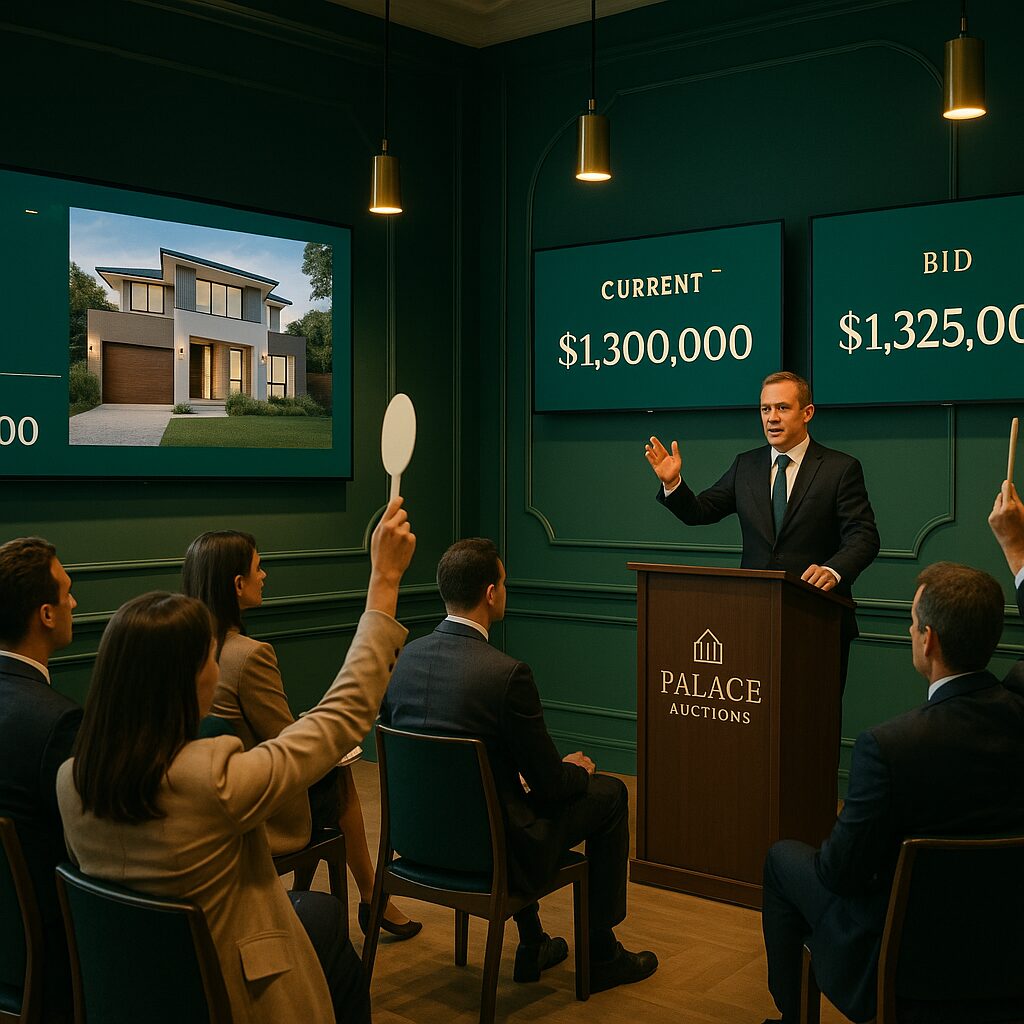
Property for sale An auctioneer stands at a podium labeled “Palace Auctions” while people raise paddles to bid on a modern house, illustrating why choose auction—bids climb from $1,300,000 to $1,325,000 as the home is displayed on a screen. Presented by Palace Auctions


Financial Advantages: The Bottom Line

Beyond speed and certainty, auctions deliver compelling financial benefits for both sellers and buyers through reduced costs and enhanced value.

Seller’s cost savings

While auction fees appear comparable to estate agent commissions, the accelerated timeline generates large savings.

  • Reduced Carrying Costs: Save over £5,000 on mortgage payments for typical properties.
  • No price reductions: Avoid successive price cuts that damage property perception.
  • Single Marketing Campaign: Concentrated promotion versus months of advertising
  • Lower legal fees: a simplified process reduces solicitors’ time.
  • Opportunity cost: faster access to capital for the next investment.

Buyer Value Opportunities

Auctions create unique value opportunities for prepared buyers:

  • Below-Market Purchases: Motivated sellers may accept competitive but fair prices.
  • No gazumping: Secure properties without rival bid concerns.
  • Transparent Pricing: Know exactly what others will pay.
  • Reduced Survey Risk: Auction packs include detailed property information.
  • Speed Premium: Secure properties before traditional buyers can act.

Success Strategies: Maximising Auction Outcomes

Understanding how to leverage auctions optimally ensures maximum benefit for both sellers and buyers.

For Sellers: Preparation and Presentation

Legal Pack Excellence: Comprehensive legal documentation accelerates buyer due diligence. Include searches, title documents, and planning permissions upfront, eliminating post-auction delays.

Strategic Guide Pricing: Set guides 10-15% below target prices, stimulating competitive bidding while protecting through reserves. Psychology research confirms that lower starting prices generate higher final bids through increased participation.

Professional Photography: High-quality imagery drives online engagement and auction room attendance. Virtual tours and drone footage particularly impact younger buyers accustomed to digital property searching.

Flexible Reserves: Maintain reserve flexibility until auction day, responding to market interest. Many sellers successfully sell “below reserve” when bidding demonstrates genuine demand slightly below expectations.

For Buyers: Research and Readiness

Financial Preparation: Secure mortgage agreements in principle or proof of funds before bidding. Relationship building with auction finance providers ensures backup options if primary funding faces delays.

Thorough due diligence: review legal packs completely, commission independent surveys, and calculate total costs including fees and renovations. Knowledge eliminates post-auction surprises.

Bidding Discipline: Set absolute limits before auctions begin, avoiding heat-of-the-moment overpayment. Consider proxy bidding to maintain emotional distance while ensuring participation.

Post-Auction Opportunities: Properties failing to meet reserves often sell post-auction at negotiated prices. Maintaining contact with auctioneers creates opportunities to secure properties outside competitive bidding.

The Future of Property Auctions

Looking ahead, property auctions will continue to evolve to meet changing market demands while preserving core advantages.

Sustainable Growth Trajectory

With 10.6% volume growth and 13.9% fund growth in 2024, auctions demonstrate sustained expansion. Economic uncertainty and interest rate fluctuations actually favour auctions, as their speed and certainty become more valuable during volatile periods.

Demographic shifts support continued growth. Millennials and Gen Z buyers, comfortable with online transactions and time-sensitive decisions, naturally gravitate towards digital auction platforms. International investment continues to expand, with UK property attracting global capital seeking transparent, efficient acquisition methods.

Regulatory Evolution

Government recognition of auction benefits may produce supportive regulation. Discussions around mandatory property information upfront—similar to auction legal packs—would level playing fields between methods. Environmental regulations making energy-inefficient properties harder to rent could drive more landlords towards auction exits.

Digital transaction legislation continues to evolve to support online auctions. Electronic signatures, digital contracts, and remote identity verification streamline processes while maintaining security.

Market Integration

The distinction between auctions and traditional sales continues to blur. Hybrid models combining private treaty marketing with auction deadlines gain popularity.

Estate agents increasingly partner with auction houses, recognising client benefits from offering both options. This integration benefits consumers through improved choice and service. Sellers can test private markets before committing to auctions, while buyers access properties through preferred channels. The future promises seamless transitions between sales methods, optimising outcomes for all parties.

Palace Auctions: Your Auction Success Partner

Choosing the right auction house determines transaction success. Palace Auctions combines decades of expertise with cutting-edge technology, delivering exceptional results for sellers and buyers across the UK.

Comprehensive Market Coverage: Our national reach ensures maximum property exposure, attracting buyers from London to Edinburgh, Cardiff to Belfast. International marketing through global property portals reaches overseas investors seeking UK opportunities.

Expert Guidance: Our specialists guide clients through every step, from initial valuation through post-completion support. We explain processes clearly, ensuring informed decision-making without overwhelming technical detail.

Proven Results: With success rates exceeding industry averages and consistent achievement of guide prices, we demonstrate why sophisticated sellers and buyers choose Palace Auctions. Our transparent fee structure and no-sale-no-fee options remove financial risk.

Technology Leadership: Our digital platform combines live-streaming auctions with comprehensive online bidding, ensuring maximum participation regardless of location. Advanced analytics help sellers price strategically while enabling buyers to assess value accurately.

Contact Palace Auctions today. Discover how auctions can transform your property transaction. Be it selling swiftly, buying aggressively, or investing shrewdly, we provide the rapidity, confidence, and benefits that exclusively auctions furnish.

Outbound Links:

Internal Link:

“View our upcoming property auctions see current opportunities.”

Page Last Updated: Tuesday, 14 October 2025, 14:43 GMT

Why Choose Auction? – Your Auction FAQ, Timeline Tool & Quick Registration

Key Takeaway: Auctions offer unmatched speed, certainty, and transparency—debunking common myths and empowering both buyers and sellers to achieve successful, stress-free property transactions.

Auction FAQ: Top 10 Misconceptions—Busted

Thinking of buying or selling at auction? Don’t let myths hold you back. Here are the facts:


  1. Auctions are only for distressed properties:
  2. False! Modern auctions feature everything from luxury homes to commercial assets—many sellers choose auction for speed and certainty, not desperation.


  1. Only cash buyers or investors can participate:
  2. Not true. While a 10% deposit is required on the day, buyers can use mortgages or bridging loans if arranged in advance.


  1. Auctions are riskier than private sales:
  2. Auctions are highly regulated, with legal packs and surveys available before bidding. Due diligence is encouraged.


  1. Guide prices reflect the expected sale price:
  2. Guide prices are marketing tools, often set low to attract interest. The final price is determined by competitive bidding and may exceed the guide.


  1. You can back out after winning the auction:
  2. Once the hammer falls, the sale is legally binding. Buyers must complete the purchase or risk losing their deposit and facing legal action.


  1. Auction fees are hidden or excessive:
  2. Fees are clearly stated in the legal pack. Review all costs, including premiums and admin charges, before bidding.


  1. Auctions guarantee a bargain:
  2. While some properties sell below market value, competitive bidding often achieves or exceeds open market prices.


  1. You can’t inspect or survey auction properties:
  2. Viewings and surveys are encouraged before auction day. Legal packs provide detailed information—consult a solicitor.


  1. Auctions are intimidating or only for professionals:
  2. The process is open, with clear rules and support for newcomers. Online and in-person bidding make auctions accessible to all.


  1. Auctions are only for local buyers:
  2. Online bidding and national marketing mean buyers from anywhere can participate, expanding competition and opportunity.


Timeline Comparison Tool: Auction vs Traditional Sale

Stage Auction Sale (Weeks) Traditional Sale (Weeks)
Marketing & Viewings 2–4 4–8
Offer/Contract Exchange Immediate (Auction) 8–16 (Negotiation & Conveyancing)
Completion 3–4 (20–28 days) 1–4
Total Duration 4–6 12–20


At a glance: Auctions typically complete in 4–6 weeks with near-zero fall-through, while traditional sales average 12–20 weeks and face up to 30% risk of collapse.

Quick Registration: Get Started Today

For Buyers:


For Sellers:


**Ready to experience the speed, certainty, and transparency of auction? Register now—our team.


Reset password

Enter your email address and we will send you a link to change your password.

Get started with your account

to save your favourite homes and more

Sign up with email

Get started with your account

to save your favourite homes and more

By clicking the «SIGN UP» button you agree to the Terms of Use and Privacy Policy

Create an agent account

Manage your listings, profile and more

Phone

Buyers will use it to contact you.

By clicking the «SIGN UP» button you agree to the Terms of Use and Privacy Policy

Create an agent account

Manage your listings, profile and more

Sign up with email