
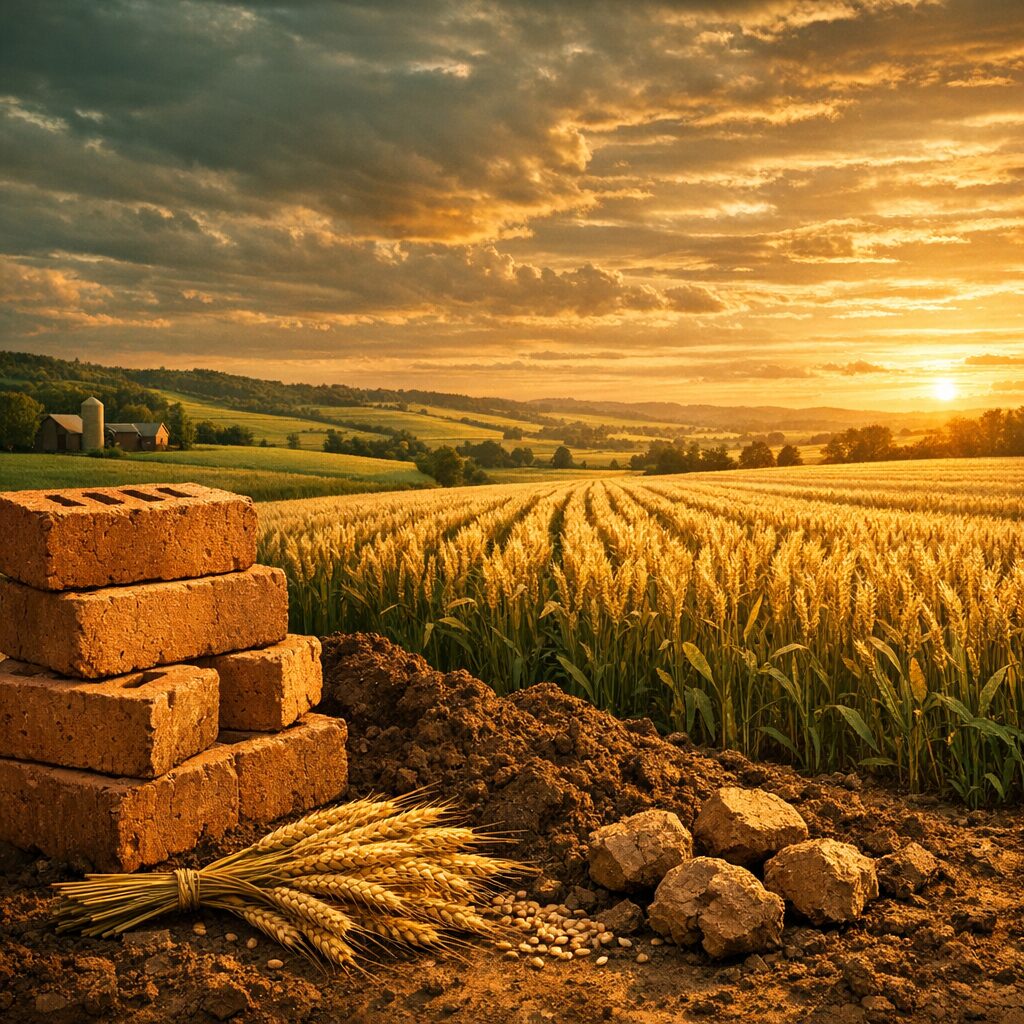

We Must Not Forget: Houses Are Built “Of or On Bricks” — Even Bricks Are Made of Clay, and Food Does Not “Come From the Supermarket”
In a world shaken by geopolitical turmoil, the enduring value of land and commodities stands out as the ultimate foundation for security, prosperity, and resilient investment. Now, more than ever, investors are reminded that real assets—land, food, and the materials that build our homes—are the bedrock of civilization and wealth.
Introduction: Crisis as a Catalyst for Clarity
As the Middle Eastern unrest of 2026 unfolds, the world is reminded—sometimes painfully—of the fundamental truths that underpin our daily lives and investment decisions. The recent escalation, marked by US and Israeli strikes on Iran, the temporary closure of the Strait of Hormuz, and the resulting surges in oil, gas, and food prices, has sent shockwaves through global markets and supply chains. For investors, policymakers, and everyday citizens, these events are not just headlines—they are a clarion call to re-examine what truly holds value in times of uncertainty.
At Palace Auctions, we believe that moments of crisis are also moments of opportunity. This article explores how the current Middle Eastern conflict has brought the intrinsic value of land and commodities into sharp focus. We will delve into the facts, supply chain fundamentals, and investment case for land. In addition, we will draw on the latest data and expert insights. Our aim is to educate, remind, and encourage investors to look beyond the noise. We also want you to invest in what is real, enduring, and essential.
Section 1: The Geopolitical Backdrop — Unrest and Its Ripple Effects
The Middle Eastern Flashpoint
In February 2026, coordinated US and Israeli strikes on Iran triggered a cascade of retaliatory actions. These actions disrupted not only military and political stability. They also disrupted the arteries of global commerce. The Strait of Hormuz—a narrow waterway through which 20% of the world’s oil and 30% of internationally traded fertilisers flow—became a focal point of risk. The closure and subsequent reopening of this chokepoint sent oil prices surging to over $94 per barrel. At the same time, natural gas prices climbed 50–70% and urea fertiliser prices spiked by 46% month-on-month.
Global Economic Fallout
The impact has been immediate and far-reaching:
- Oil and Gas: Brent crude averaged $60/barrel for 2026, but with a persistent “war premium” overlay. Natural gas prices soared, and energy-importing nations scrambled for alternatives .
- Food and Fertilizer: Wheat prices rose 13%, maize 4%, and rice 5%. The World Bank warned that 45 million people could be pushed into acute hunger if disruptions persist .
- Supply Chains: Insurance premiums for shipping through the region jumped from 0.25% to as high as 10% of vessel value, resetting every seven days .
- Business and Markets: Singapore rolled out a $780 million emergency package to cushion its economy, South Asian growth slowed, UBS lowered its S&P 500 target, and companies like Wizz Air and Berkeley Group reported significant profit hits and sentiment impacts .
Key Finding:
The Middle Eastern unrest has exposed the fragility of global supply chains and the critical importance of physical assets—land, energy, and food—in sustaining economies and societies.
Section 2: Land and Commodities — The Foundations of Civilization
Bricks, Clay, and Construction: From Earth to Home
Every house, every building, every piece of infrastructure begins with the land. Bricks are made from clay, quarried from the earth, shaped, and fired—a process as old as civilisation itself. The UK produces over 1 million tonnes of mineral products daily. Meanwhile, domestic industry supplies 90% of aggregates and 100% of cement and lime, supporting 11% of the UK economy.
Supply Chain Fundamentals
- Raw Materials: Clay, sand, gravel, and limestone are extracted from the land, processed, and transformed into bricks and concrete.
- Energy Dependency: The production of bricks and cement is energy-intensive, making it vulnerable to spikes in oil and gas prices.
- Innovation: The UK industry is reducing embodied carbon by up to 30% through the use of reclaimed clay and brick waste, reinforcing the value of local, sustainable resources .
Investor Insight:
The value of land is not just in its location, but in its ability to yield the materials that build our homes and cities. In times of supply chain disruption, the security of local resources becomes paramount.
Food Security: From Field to Table
Food does not “come from the supermarket.” It comes from the land—tilled, planted, and harvested by farmers, then transported through a complex, vulnerable supply chain. The Middle Eastern conflict has underscored the fragility of this system:
- Fertilizer Disruptions: The Strait of Hormuz is a major conduit for fertilizers. Disruptions have driven up urea prices by 46% month-on-month, threatening crop yields worldwide .
- Crop Prices: Wheat, maize, and rice prices have all risen, with the FAO warning that even modest reductions in fertilizer use can cause disproportionately large declines in yields .
- Hunger Risk: The World Bank estimates that 45 million additional people could face acute hunger by mid-2026 if the crisis persists .
Key Takeaway:
The intrinsic value of agricultural land is magnified in times of crisis. It is not just an investment—it is a source of sustenance, security, and resilience.
Section 3: The Investment Case for Land — Resilience in Uncertain Times
Land as a Tangible, Intrinsic-Value Asset
Land has always been a safe haven in turbulent times. Unlike digital assets or paper wealth, land possesses intrinsic value derived from its utility, scarcity, and the essential goods it produces.
Performance and Price Resilience
- Global Farmland Values: Up 18% in 2024 (Savills Global Farmland Index) .
- Western Europe: Farmland values rose nearly 4% in 2024 .
- UK Agricultural Land: Appreciated 6–8% annually over the long term; up 26% over five years, outperforming prime central London property .
- Current Values: Bare agricultural land averages just under £8,700/acre in England and Wales; prime arable land in East of England at £9,368/acre .
- Development Land: Outline residential planning permission can raise values to £250,000–£750,000/acre; detailed planning can push values to £500,000–£2,000,000+/acre .
Rental and Yield Opportunities
- Agricultural Land Rental: Arable land lets for £100–£250/acre annually; grazing land for £50–£150/acre .
- Regional City Yields: Manchester, Birmingham, and Liverpool delivering 7–9% gross yields on auction purchases .
- Northern Ireland: Annual house price growth at 11%—almost four times the UK average .
Expert Quote:
“There will always be demand for food, fibre and fuel.” — Jonny Griffiths, Head of International Farmland, Savills
Demand Drivers: Food Security, Population Growth, and Sustainability
- Population Growth: Global demand for food and housing continues to rise.
- Finite Resource: Land is limited and irreplaceable, underpinning its long-term value.
- ESG Alignment: Land investment aligns with environmental, social, and governance goals, attracting institutional and conservation buyers .
- Government Policy: UK government’s commitment to food security and sustainable development supports land values .
Section 4: Commodities in Crisis — Oil, Gas, and the Cost of Instability
Energy Markets: The Lifeblood of Modern Economies
The Middle East supplies around 30% of global oil and 17% of natural gas. The recent conflict has created the largest supply disruption in oil market history, with crude flows through the Strait of Hormuz plunging and LNG supplies from Qatar and the UAE reduced by over 300 million cubic metres per day.
Price Shocks and Knock-On Effects
- Oil Prices: Surged by $20 per barrel to over $94, with a “war premium” persisting .
- Natural Gas: Prices up 50–70%, with further increases possible if the crisis continues .
- Fertilizer: Urea prices up 19% in the first week of March; Egyptian urea up 28% .
These shocks ripple through the economy, raising the cost of producing and transporting construction materials and food, and ultimately impacting consumers and investors.
Investor Insight:
Assets tied to secure, resilient supply chains—whether in energy, construction, or agriculture—are more valuable in a world of uncertainty.
Section 5: Supply Chain Fundamentals — From Earth to Economy
Construction Materials: Bricks, Metals, and the Value of Local Resources
- UK Mineral Products: Over 1 million tonnes produced daily; domestic industry supplies 90% of aggregates and 100% of cement/lime .
- Metals: The Middle East produces around 8% of global aluminum; global metals supply chains are highly interconnected and vulnerable to disruption .
- War-Risk Insurance: Premiums for shipping through conflict zones have risen from 0.25% to 10% of vessel value .
Agricultural Commodities: The Chain from Land to Table
- Fertilizer Dependency: 30% of internationally traded fertilizers pass through the Strait of Hormuz .
- Yield Risks: FAO warns that even modest reductions in fertilizer use can cause large declines in crop yields .
- Food Inflation: Food inflation has exceeded 5% in half of low-income countries .
Key Takeaway:
The security and resilience of supply chains for construction and food are directly tied to the land and resources beneath our feet.
Section 6: The Auction Advantage — Palace Auctions’ Perspective
Liquidity, Transparency, and Opportunity
At Palace Auctions, we have witnessed firsthand the enduring appeal of land and property assets, even in times of uncertainty:
- Clearance Rates: Consistently exceeding 74%, with 30–40% of buyers from overseas .
- Auction Market Growth: Increases in both the number of lots sold and total funds raised in 2025 .
- Regional Strength: First-time buyers and buy-to-let investors are returning, attracted by rental growth and capital appreciation .
Why Invest Now?
- Resilience: Land values have demonstrated remarkable resilience, underpinned by food security, population growth, and the finite nature of the resource.
- Yield: Regional cities offer strong gross yields, and agricultural land provides stable rental income.
- Long-Term Growth: Strutt & Parker forecasts values to remain broadly stable in 2026, with a recovery projected from 2027 .
- Global Appeal: Nearly half of surveyed family offices intend to increase their property allocation in the next 18 months .
Palace Auctions’ Commitment:
We guide our clients through every stage of the investment process, offering access to premium listings, expert insights, and a transparent, efficient marketplace.
Section 7: Positive Outlook — Opportunities Amidst Uncertainty
Gold as a Safe Haven
- Gold Prices: Up 42% in 2025, reflecting investor demand for tangible, safe-haven assets .
Land as the Ultimate Store of Value
- Intrinsic Value: Land is the foundation of all other value, immune to currency devaluation, cyber risk, or financial contagion.
- Stewardship: Investing in land is not just about returns—it is about stewardship, sustainability, and securing the essentials of life for future generations.
Expert Perspective:
“With land being a finite resource and in demand to meet government targets across development, agriculture, energy and environment, values will remain firm.” — Savills
Conclusion: Invest in What Endures — The Call to Action
The ongoing Middle Eastern unrest has brought into sharp focus the true intrinsic value of land and commodities. In a world of digital abstractions and financial engineering, it is easy to lose sight of the physical realities that underpin our economies and societies. Yet, as recent events have shown, when crisis strikes, it is the ownership of land, the control of resources, and the possession of essential materials that determine who thrives and who merely survives.
What Houses
Houses are indeed built “of or on bricks,” and even bricks are made of clay. Food does not “come from the supermarket”—it comes from the land, nurtured by the labour of farmers and the infrastructure that connects fields to tables. Oil, natural gas, metals, and agricultural staples are not just commodities—they are the lifeblood of civilization.
For investors, the message is both timeless and timely:
Return to the fundamentals. Invest in what is real, what is tangible, and what endures. Land and commodities are not just assets—they are the foundation of value itself.
Palace Auctions — Your Partner in Real Asset Investment
As we navigate the challenges and opportunities of 2026, Palace Auctions stands ready to help you secure your future with investments grounded in the enduring value of land and commodities. Explore our latest listings, attend our upcoming auctions, and let our expert team guide you toward resilient, rewarding opportunities.
Now, more than ever, is the time to rediscover the intrinsic worth of land. Invest Auctions.
Recommendations
|
Anchor Text |
URL |
Justification |
|
Luxury Property Auction Insights: London Market Trends |
Central hub for market news, trends, and investment analysis; reinforces the article’s themes and Palace Auctions’ authority. |
|
|
Property Auction Yields Hit 8.85%: How to Choose the Best Investment Properties |
Data-driven insights for investors; supports the article’s focus on resilient property investment during global crises. |
Outbound Linking Recommendations
|
Anchor Text |
URL |
Source |
Justification |
|
Six ways the Iran war could affect you – in charts |
BBC News |
Authoritative, visual summary of the Middle East conflict’s impact on oil, food, and commodity prices. |
|
|
Spotlight: Global Farmland – September 2025 |
Savills |
Latest data and analysis on global farmland values and investment trends. |
|
|
Food Security Update – April 2026 |
www.worldbank.org/en/topic/agriculture/brief/food-security-update |
World Bank |
Up-to-date analysis of food security and commodity price risks due to geopolitical unrest. |
|
FAO Food Price Index |
FAO |
Definitive monthly data on global food and fertilizer price t |